
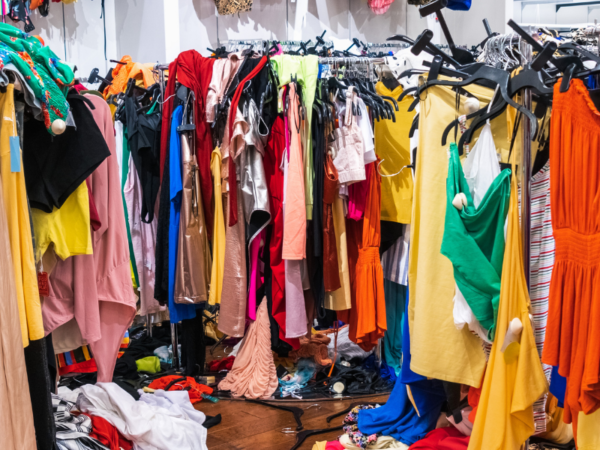
Guest article written by Sarah Jones, a high school student at H-B Woodlawn. She is passionate about caring for our environment and is currently working towards her Girl Scout Gold Award. The article and her research is part of this project.
The 21st century has drastically transformed the fashion industry, with fast fashion brands making clothing more affordable, more accessible and more trend-driven than ever before. Consumers now purchase significantly more clothing, treating garments as disposable items, sometimes even buying clothing for one-time wear. Although this transformation has had significant benefits for retailers and for consumers seeking affordable clothing, it has had negative effects on our environment.
Overconsumption of clothing is a critical issue our planet is facing at the moment. Yet, many people remain unaware of the global threat. When you purchase your clothes, you are most likely worrying about the cost, but have you thought about just how bad it is for our environment?
The entire process of producing a piece of clothing, from manufacturing to transportation to finally ending up in a landfill, results in 1.2 billion tons of carbon emissions released by the fashion industry every year.
With every piece of clothing you purchase, you are contributing to the destruction of the environment. The production of clothing contributes to several negative environmental effects: with the enormous amounts of water it uses, the amount of greenhouse gases it releases, the amount of pesticide runoff, and the microplastic contamination it causes, as well as the millions of tons of waste that end up in landfills each year. As consumer demand for inexpensive and quickly made products continues to drive the fast fashion industry, our environmental concerns also continue to accelerate. The overconsumption of clothing has accelerated climate change and landfill waste in the 21st century due to the increase in greenhouse gas emissions, the encouragement of quick textile production and the rapid disposal of clothing.
An Increase In Carbon Emissions
One of the most significant ways in which overconsumption of clothing has accelerated climate change is through the increase in carbon emissions. Many people may assume that most of our carbon emissions are from causes such as air travel, but that is not the case. The fashion industry accounts for 10% of global pollution, which is higher than emissions from air travel. The entire process of producing a piece of clothing, from manufacturing to transportation to finally ending up in a landfill, results in 1.2 billion tons of carbon emissions released by the fashion industry every year. To put this into perspective, 1.2 billion tons of carbon emissions is equivalent to taking all 254 million passenger vehicles in the U.S. off the road for an entire year.
A major reason for the significant amount of carbon emissions that the fast fashion industry produces is that consumers continue to buy items to wear once or a handful of times. Purchasing more clothing encourages companies to produce garments quickly, which requires enormous amounts of energy for manufacturing, transportation and distribution. Not only are consumers buying clothing to only be worn a couple of times, but they often do not dispose of their clothing in a sustainable manner, leading to an increase in clothing ending up in landfills. The perception that it is okay to use clothing only a handful of times is something that needs to be addressed if we want the industry’s carbon footprint to be reduced, as within the first decade and a half of the 21st century, clothing production has doubled. This is seen with most European brands having gone from releasing two collections per year, for the summer and winter seasons, to now releasing as many as 24 collections per year. This has resulted in clothing utilization decreasing by 36% between 2003 and 2018, with a third of young women believing that a garment is considered “old” after it has been worn once or twice. The idea that individuals can only wear a piece of clothing a few times before it is considered outdated or old is furthering our clothing overconsumption crisis and is extremely dangerous to the state of our climate.
A Greater Acceleration of Climate Change
The significant increase in the amount of clothing produced is a direct cause of the rise in carbon dioxide levels. As previously stated, it requires a lot of energy to produce, transport and dispose of the clothing. The production, transportation and disposal of clothing increases carbon emissions for several reasons, one of them being that clothing factories heavily rely on electricity generated from fossil fuels such as coal, oil and natural gas. When these fuels are burned, carbon that has been stored underground for millions of years combines with oxygen in the atmosphere, producing carbon dioxide, a greenhouse gas that traps heat in the Earth’s atmosphere. According to Nature News, over 60% of textiles are used in the fashion industry and a large proportion of clothing manufacturing occurs in China and India, both countries of which rely on coal-fueled power plants. These power plants convert the coal-fueled power into electricity, and as a result are increasing the footprint of each garment, meaning that around 5% of total global emissions come from the fashion industry. Ultimately, as consumer demand for fast fashion continues to increase, companies will continue to produce more clothing to satisfy consumers’ needs, and will continue to operate more factories, transport more products worldwide and generate more waste. This whole cycle of consumers wanting quickly and cheaply made clothing, and companies wanting to satisfy those needs to make more profit, means greater fossil fuel consumption, higher concentrations of carbon dioxide in the atmosphere and a greater acceleration of climate change.
In addition to the greenhouse gas emissions produced by clothing overconsumption, it has also increased the use of the world’s water resources. Once again, this is due to consumer demand, with people buying more clothes and therefore requiring more cotton production and textile manufacturing.
These dyes are not only visually polluting, turning rivers into unnatural hues, but they also pose serious threats to aquatic life and potentially human health.
Sustainability directory
A Waste of Water
The fashion industry is the second-largest consumer of water among all industries, requiring an astonishing 700 gallons of water to produce one cotton shirt and 2,000 gallons of water to produce a pair of jeans. Many of us may not have been aware of the significant amounts of water used to simply make one shirt or one pair of jeans, but the whole process of producing these items uses a lot more water than we would expect. The journey begins with cotton farming, where vast quantities of water are diverted for irrigation, and it often occurs in regions that are already facing water scarcity. Next comes the process of turning the raw cotton into fabric, where textile mills, especially those used by fast fashion brands, are looking to make clothes as cheaply as possible. As a result, they often discharge untreated or poorly treated wastewater, a mix of toxic chemicals, directly into waterways. The increase of toxic chemicals is something that we should all be more focused on. According to a 2025 article by the Sustainability Directory, these dyes are not only visually polluting, turning rivers into unnatural hues, but they also pose serious threats to aquatic life and potentially human health.
Chemical Pollution
Beyond its impact on greenhouse gas emissions and water use, it is also increasing chemical pollution, creating harmful effects on ecosystems, water sources and human health. The textile industry not only uses dyes, but also uses a significant amount of other chemicals, such as bleaching agents like chlorine, fixing agents to improve colorfastness, and finishing chemicals to impart wrinkle resistance or water repellency, the Sustainability Directory reported. These toxic chemicals are introduced at nearly every step of the fast fashion supply chain, from fiber cultivation to finishing and transport. The chemical inputs begin at the fiber stage, with conventional cotton cultivation involving intensive pesticide and fertilizer use and creating exposure risks for agricultural workers and nearby communities. In addition, synthetic fibers, such as polyester, also involve chemical-intensive manufacturing processes. They are derived from petrochemical feedstocks and may incorporate flame retardants, plasticizers and other additives during production, according to a 2026 report by Enhesa. The substances are often discharged without adequate treatment, which leads to contamination of water sources and the disruption of aquatic ecosystems, ultimately making water unsafe to drink. The negative result of textile production goes even further than its immediate impact; it also leads to long-term contamination and ecological damage due to chemicals persisting in the environment, the Sustainability Directory reported in 2025. The toll that these toxic chemicals have on the environment is significant, with textile dyeing widely cited as a major contributor to global industrial water pollution, second only to agriculture, according to the Sustainability Directory.
Chemical pollution from clothing overconsumption is not only affecting the environment but is also affecting human health
Factories discharge dye effluent without adequate treatment that can be enormously dangerous to our environment, as it contaminates waterways, affecting drinking water supplies and aquatic ecosystems. In addition, if these substances are persistent in soil and sediment, they adversely affect agricultural crops and biodiversity, according to Enhesa. Chemical pollution from clothing overconsumption is not only affecting the environment but is also affecting human health. Workers in textile factories face the highest risk of adverse effects from chemical exposure; these factory workers inhale dye powders and formaldehyde fumes, which may contribute to respiratory problems. They are also in direct contact with acids and solvents that can cause skin irritation or burns. In addition, they have prolonged exposure to certain azo dyes and heavy metals, which have been linked to an increased cancer risk over time. Not only are factory workers at risk for health problems from clothing, but so are consumers. Consumers may also encounter residual substances in finished garments. Studies have identified detectable levels of formaldehyde, phthalates and azo dye byproducts in clothing sold in major stores. Although concentrations are usually low, repeated dermal exposure can be a concern, particularly to those who are more sensitive, such as infants and children, Enhesa reported. The environmental impacts of clothing overconsumption are not limited to manufacturing regions; they occur throughout the lifecycle of a piece of clothing, with garments continuing to release microplastics and chemical additives during washing. With this all being said, when going out to shop for clothing, we should all keep in mind that this growing demand for inexpensive clothing is encouraging production methods that release harmful chemicals into the environment, and that overconsumption contributes to both pollution and long-term ecological damage.
Clothes are being disposed of quicker now than ever before, as consumers purchase more and more clothing. As a result, the crisis of clothing overconsumption has accelerated and increased the amount of landfill waste each year.
Faster Lead Times Produce Obscene Amounts of Waste
The time it takes for a company to get a product through the supply chain, starting at the design through to the purchase, is called the lead time. Over the past few decades, this lead time has continued to reduce. In 2012, Zara was able to design, produce and deliver a new garment in two weeks, Forever 21 in six weeks, and H&M in eight weeks. It is even more extreme for major Chinese fast fashion companies, such as Shein, which have garments ready in an astonishing 10 days. This may seem like a good thing, with consumers having easier and quick access to essentially any clothing piece they would ever want, but the reality is that this ultimately produces obscene amounts of waste. According to the 2015 documentary “The True Cost,” the world is now consuming 400% more than 20 years ago, consuming around 80 billion new pieces of clothing every year, with the average American generating 82 pounds of textile waste, writer Rashmila Maitra noted in a 2025 article.
A garbage can’s worth of textiles is sent to landfills every second
Materials circular Economy
The Environmental Consequences
The environmental consequences of clothing overconsumption, which is greatly accelerating climate change and landfill waste, demonstrate that not only is overconsumption of clothing a huge crisis, but it is a crisis that needs to be resolved now. Research and evidence show that the fashion industry contributes significantly to climate change through releasing greenhouse gases into the atmosphere, excessive water consumption, chemical pollution and the increase in textile waste. According to Earth.Org, the fashion industry is responsible for approximately 10% of global carbon emissions, while research from Materials Circular Economy stated that a garbage can’s worth of textiles is sent to landfills every second. These statistics are a good representation of how serious the clothing overconsumption crisis really is and how it goes beyond just what individuals purchase. Although clothing overconsumption leads to lower prices and constant access to new styles, and can seem beneficial to consumers, these advantages come at the stake of our natural resources, ecosystems and the future of our environment. This continued growth of clothing overconsumption worsens our planet more and more each day and degrades our environment. This should be viewed as a significant problem having harmful effects on climate change and landfill waste that do not outweigh the short-term benefits of cheap and readily available fashion.
Shop Quality Over Quantity
Support Small Businesses
Make Environmentally Friendly Clothing Purchases
Knowing all the significant environmental effects that clothing overconsumption has on the environment, we should all work together to make an effort to be more environmentally friendly when it comes to our clothing purchases. There are several approaches to this, one of the major ones being to shop for quality over quantity. This means that instead of buying five pieces of poor-quality clothing, buy a couple of good-quality clothing items, as that means you are more likely to keep the clothing longer and therefore less clothing will end up in landfills. Another major approach is to support small businesses rather than large corporations, such as Shein. This is because, as explained by Dr. Sheng Lu, corporations are increasing their production speed due to consumer demand. If consumers start to buy less from large corporations, they will produce less clothing, therefore once again improving our environment.
Support a Local Pop-up Shop December 6
If you would like to support a locally run free clothing pop-up shop, look forward to attending Arlington Students for Climate Action’s shop this December. The event will take place Dec. 6, from 12:00 p.m. to 4:00 p.m., at the Central Library auditorium. The event will be like a mini thrift store, where you can bring in your used clothes to exchange for others’ used clothing.
Arlington Students for Climate Action
Pop-up Shop
December 6, 2026
12:00-4:00 PM
Central Library auditorium
Please take a moment to provide feedback
Help Sarah Achieve Her Girl Scout Gold Award
Sarah is writing this article as part of her Girl Scout gold award. The goal of her gold award is to educate the public on the highly negative effects clothing overconsumption is having on the environment through her article and pop-up shop. She would love it if you would take a very quick survey to give her some feedback on the article.
 Save Your Seat for our Rooted in Our Community Luncheon on February 11, 2027